As an Amazon Associate, we earn from qualifying purchases. Some links on this site are affiliate links at no extra cost to you. Our recommendations are based on thorough research and editorial judgment.


Ceramic Space Heaters Explained: How They Work

Ceramic space heaters operate through resistive heating, where electric current flows through resistive materials, generating heat. These heaters often utilize PTC ceramic materials, such as barium titanate, to enhance thermal regulation and prevent overheating. According to Joule’s Law, heat production is proportional to current and resistance. With a typical wattage of around 1,500 watts, they efficiently heat rooms up to 250 square feet. This technology represents a shift toward safer, energy-efficient heating solutions, promising further innovations in design and performance.
Key Takeaways
- Ceramic space heaters operate using resistive heating, converting electrical energy into heat through high-resistance ceramic materials and efficient heat transfer mechanisms.
- PTC ceramics enhance thermal stability by increasing resistance with temperature, preventing overheating and ensuring consistent heat output.
- Internal fan systems in ceramic heaters improve airflow and facilitate even heat distribution, while models without fans utilize conduction and infrared radiation.
- Ceramic heaters are energy efficient, converting nearly 100% of electrical energy into heat, with thermostatic controls minimizing energy waste.
- Built-in safety features, such as overheat protection and tip-over switches, enhance user safety, making ceramic heaters suitable for various residential and commercial applications.
Understanding Resistive Heating
You may be interested



Resistive heating is a fundamental principle utilized in ceramic space heaters, where electric current flows through a resistive material, generating heat through Joule heating. This process is defined by Joule’s first law, indicating that the power ( P ), measured in watts, is equal to the square of the current ( I ) multiplied by resistance ( R ). Ceramic materials exhibit substantial electrical resistance, allowing them to efficiently convert electrical energy into heat. Their thermal conductivity enhances the distribution of warmth, guaranteeing uniform heating throughout the ceramic block. Unlike metal wire resistors, ceramic’s stable resistance supports consistent heat output. This characteristic, coupled with attached metal fins, guarantees effective heat transfer to the surrounding air, optimizing a ceramic heater’s overall performance. Additionally, energy-efficient modes implemented in modern ceramic heaters help reduce power consumption while maintaining comfort.
The Role of PTC Ceramic Material
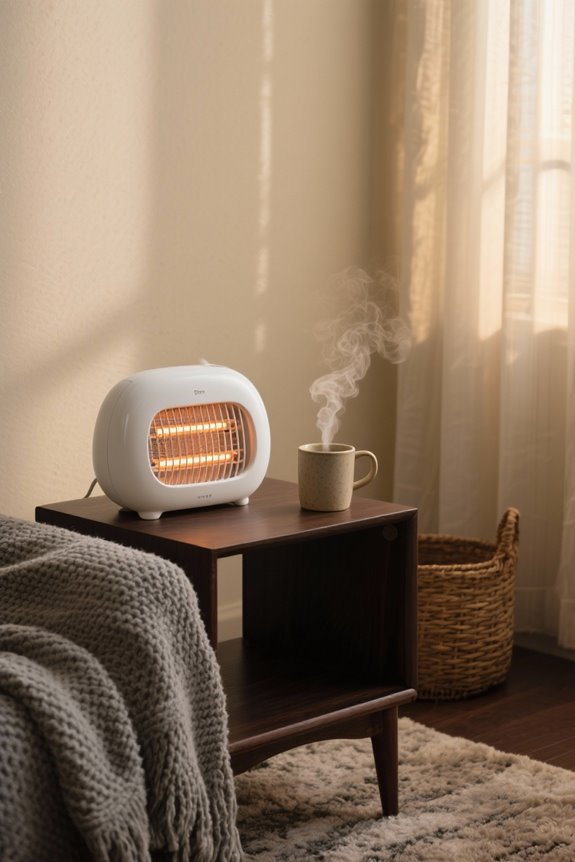
PTC ceramic material plays an essential role in the efficiency and safety of ceramic space heaters. Composed primarily of barium titanate, its PTC properties enable effective energy conversion through self-regulating behavior, which enhances heat regulation without requiring additional control mechanisms. As the temperature rises, the material’s electrical resistance increases, automatically reducing the current flow and preventing overheating. This intrinsic safety feature contributes to material durability, allowing for consistent thermal stability in varying conditions. Efficient heat transfer occurs as heat moves to metal fins, maximizing airflow. With rapid response capabilities, PTC ceramics guarantee even heating, achieving efficiency gains while maintaining low maintenance. Overall, these characteristics make PTC ceramic material fundamental to the reliable operation of modern ceramic space heaters. Additionally, quartz heaters utilize radiant heating technology to warm nearby objects efficiently, showcasing a different approach to effective space heating.
Joule’s Law and Heat Generation
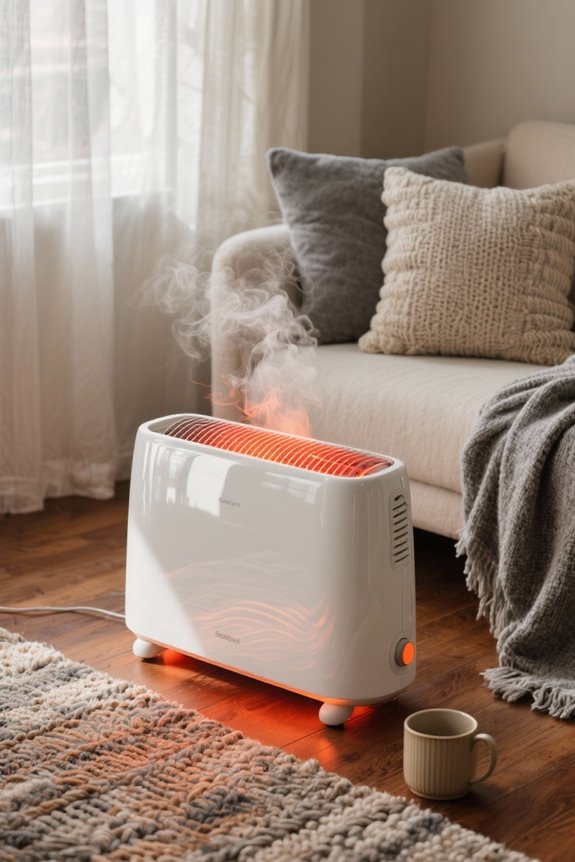
When electric current travels through a conductor, it generates heat due to Joule’s Law, a fundamental principle in thermodynamics. This law quantifies heat generation by stating that the heat produced (Q) is equal to the current squared (I²), multiplied by the resistance (R) and the time (T) the current flows: ( Q = I^2 R T ). Joule heating is essential to understanding heat generation, as it reveals that heat production increases quadratically with current. Factors like thermal conductivity affect how effectively this heat transfers. For instance, a conductor with high thermal conductivity dissipates heat quickly, enhancing efficiency. This relationship between current, resistance, and time is vital for designing effective ceramic space heaters, ensuring ideal heat output and energy efficiency. Incorporating high-density memory foam in designs can similarly enhance thermal regulation in products that require consistent comfort.
Composition of Ceramic Heating Elements
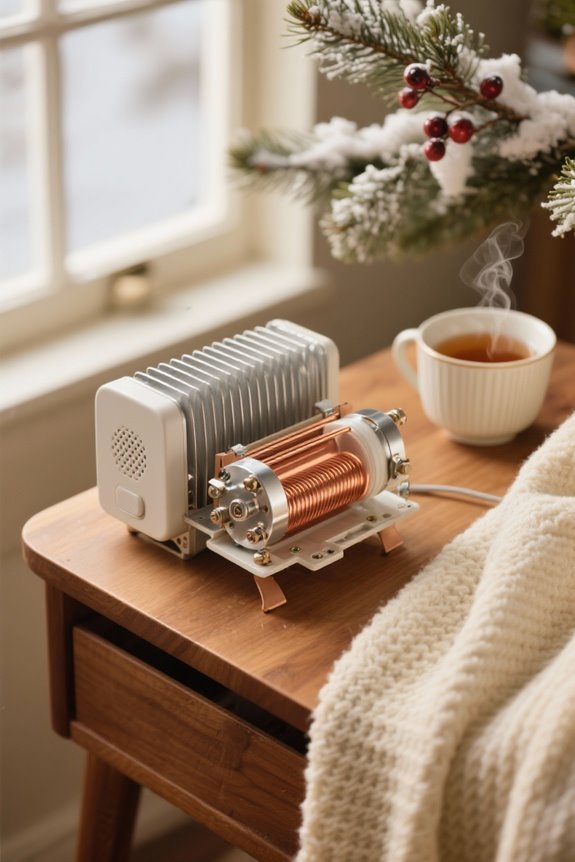
The composition of ceramic heating elements greatly influences their performance and efficiency in various applications. Common ceramic compositions include silicon carbide (SiC), which endures high temperatures of up to 1973 K, and aluminum nitride (AlN), known for its superior thermal conductivity. Molybdenum disilicide (MoSi2) boasts a melting point around 2173 K, while silicon nitride (Si3N4) withstands temperatures exceeding 1673 K. Aluminum oxide (Al2O3) offers excellent thermal and chemical resistance. These materials possess essential properties such as low thermal expansion and chemical inertness, contributing to longevity and effectiveness. Additionally, Positive Temperature Coefficient (PTC) ceramics adjust resistance with temperature, enhancing control. By utilizing these varied heating materials, manufacturers achieve desired performance characteristics tailored for specific industrial and consumer applications. Furthermore, ceramic heaters often utilize energy-efficient heating technology to optimize their performance in residential spaces.
Durability and Longevity of Ceramics

Ceramic space heaters typically offer a lifespan ranging from 5 to 10 years with proper care and usage. The durability factors influencing longevity include build quality, usage frequency, and maintenance practices. High-quality internal components, such as heating elements and housing, contribute greatly to overall durability. Fewer moving parts also enhance lifespan potential compared to other heater types. Regular maintenance practices, like cleaning air intake and exhaust vents, prevent overheating and component wear. Environmental conditions, such as dust or moisture, can negatively affect performance and durability. Adhering to manufacturer guidelines for periodic inspections and storage guarantees peak operation. By focusing on these aspects, users can maximize their ceramic heater’s effectiveness and extend its working life considerably. Additionally, safety features such as overheat protection are crucial for ensuring the heater operates safely over its lifespan.
Mechanisms of Heat Distribution
Efficient heat distribution is essential for maximizing the effectiveness of space heating. Ceramic space heaters utilize an internal fan system that markedly enhances airflow patterns, circulating warm air quickly throughout a room. The ceramic plates, which generate heat through resistance heating, have excellent thermal conductivity, ensuring quick heat retention and efficient energy conversion. As air moves over the hot ceramic surfaces, convection currents form, delivering warmth uniformly and reducing cold spots. Models without fans emit gentle, localized warmth primarily through conduction and infrared radiation. This balance allows for effective heating in both small and medium spaces, ensuring comfort while maintaining energy efficiency by minimizing electricity consumption. The integration of thermostatic controls further enhances sustained, consistent heating. Additionally, these heaters often feature Smart ECO modes that adjust energy output based on room temperature for optimal efficiency.
Convection vs. Infrared Heating
When comparing convection and infrared heating, a fundamental distinction arises in how heat is delivered and experienced in a space. Convection heating, used by ceramic heaters, warms the air first and then distributes that warmth throughout the room. This method can take longer to raise the overall temperature. In contrast, infrared heating targets objects directly, producing nearly instant warmth and retaining heat longer after the heater is turned off. Infrared heaters are generally more energy-efficient, converting electrical energy into usable heat at nearly 100% efficiency. While convection heating can dry out the air and may be noisier due to fan operation, infrared heating maintains moisture levels and operates silently, making it an appealing option for many settings. Additionally, focused heating from infrared systems can lead to improved energy savings by efficiently warming occupied spaces.
The Importance of Forced Air Circulation
Forced air circulation is a critical element in the effectiveness of ceramic space heaters. These devices employ electric-powered fans to actively move air over heated ceramic plates, considerably enhancing air circulation and heating efficiency. As electricity heats the ceramic, the built-in fan blows warm air outward, rapidly increasing the room’s temperature. This approach allows the heater to cover more area compared to reliance on radiant heating alone, which primarily warms objects directly in front of the unit. The incorporation of oscillating fans in some models further enhances even warmth distribution throughout the space. Adjustable fan speeds provide control over heat delivery, accommodating various room sizes and needs. Overall, forced air circulation proves essential for effective and efficient heating in diverse applications. Many models also incorporate safety features to ensure safe operation during use.
Energy Efficiency of Ceramic Heaters
Ceramic space heaters offer notable advantages in energy efficiency, utilizing advanced technologies that maximize heat output while minimizing energy consumption. These heaters often employ PTC heating elements, converting nearly 100% of electrical energy into heat. Equipped with thermostatic controls, they maintain consistent temperatures and reduce energy waste by cycling on and off as needed. Fan-assisted models distribute heat evenly across heating zones, minimizing the amount of energy required to maintain a warm environment. Compared to central heating systems, ceramic heaters can lead to significant energy savings, particularly when used for zone heating. Operating at about $0.20 per hour, they present a cost-effective solution for localized warmth without incurring the expenses associated with more extensive heating methods. Additionally, maintaining optimal humidity levels can further enhance comfort and energy efficiency in heated spaces.
Recommended Products

HELIOVISION Flame Technology offers a rich, realistic flame display
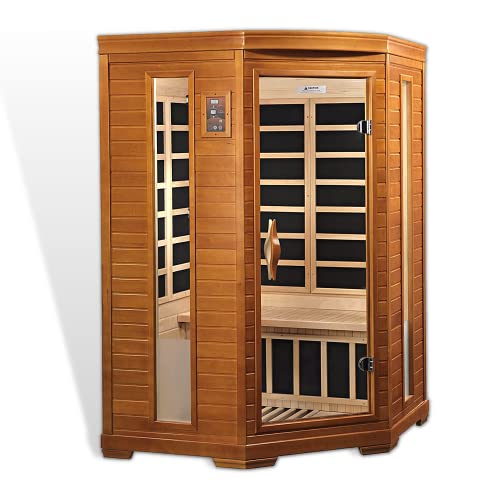
DELIVERY INSTRUCTIONS: For a smooth and successful delivery of your sauna, please provide a valid phone number for scheduling the delivery appointment. Please note that remote locations and dead-end streets may not be accessible for delivery. The sauna will be delivered to the curbside only by a semi-truck.

🔥High-Powered Heating: This 4500W electric infrared heater provides instant, even heat with sophisticated infrared technology that concentrates heat onto individuals and objects. It efficiently heats up to 143 Sq Ft of area, turning your outdoor living area into a luxurious warm retreat in no time.
Advantages Over Traditional Heating Methods
Numerous advantages position ceramic space heaters as a superior alternative to traditional heating methods. Primarily, they exhibit enhanced safety features, operating at lower surface temperatures, which reduces burn hazards. Built-in overheat protection and automatic shut-off mechanisms, especially when tipped over, elevate safety, particularly for households with children or pets. Furthermore, their durability guarantees longer lifespans; ceramic elements resist wear and thermal stress better than metal coils, often resulting in fewer maintenance requirements. User preferences also dictate that ceramic heaters provide quieter operation, mitigating distracting noises common with fan-based models. Additionally, their compact design allows for efficient heat retention and targeted localized heating, optimizing energy use while fitting seamlessly into varied spaces, thereby catering to the growing demand for adaptable heating solutions. Notably, energy-efficient designs in many ceramic models help to reduce overall heating costs, making them an economical choice for consumers.
Recommended Products

Powerful 83500 BTU 6+1 Burner System & 688 Sq.In Cooking Area: Features 6 high-efficiency main burners + 1 ceramic infrared rear burner, delivering 83,500 BTU of consistent heat for versatile grilling. The 688 sq.in cooking area (with 8mm stainless steel grids) and large warming rack provide ample space to prepare meals for a crowd—perfect for backyard barbecues, patio parties, and family gatherings

Powerful 59500 BTU 4+1 Burner Grilling System: Equipped with 4 main stainless steel tube burners and 1 ceramic infrared rear burner, delivering consistent high heat for perfect grilling. The 484.5 sq.in (28.94"x18.11") cooking area with 8mm stainless steel grids easily serves 5-8 people, ideal for backyard barbecues and family gatherings
Common Applications of Ceramic Space Heaters
When seeking efficient heating solutions, ceramic space heaters find applications in various settings, from residential to commercial. In residential usage, these heaters effectively warm small- to medium-sized rooms, including bedrooms and home offices, with typical wattage around 1,500W. They can proficiently heat spaces ranging from 150 to 250 square feet. Portable models allow users to address specific heating gaps in homes lacking adequate central heating. In commercial applications, ceramic heaters serve public venues and restaurants, enhancing comfort in conference rooms and extending outdoor seating during colder months. Additionally, they are useful in office environments for zone heating, focusing warmth on occupied workstations, while ceiling-mounted models distribute heat across larger communal areas, ensuring efficient operation in diverse settings.
Recommended Products

Panoramic 180° Viewing Experience: Frameless three-sided glass design offers an ultra-wide view of vivid flames visible from the front and sides, transforming any wall into a stunning focal point.

Design: The Dimplex Multi-Fire XHD firebox has been made and positioned to give the illusion of depth and appearance of burning firewood with a clean-face design that offers flawless panoramic views.

REALOGS PLUS TECHNOLOGY: With this special technology, the faux logs glow with authentic realism and shine day or night and it feels like you're looking at a real fireplace. Bundle includes log set & glowing ash mat.
Safety Features of Ceramic Heaters
A variety of safety features enhance the reliability of ceramic space heaters, making them suitable for diverse environments. Many include built-in overheating protection, automatically shutting off when internal temperatures exceed safe limits, minimizing fire risk. Tip-over safety switches are also standard, cutting power if the heater is knocked over to reduce burn risks considerably. Additionally, Positive Temperature Coefficient (PTC) self-regulation controls heat output based on ceramic resistance, preventing severe overheating. The cool-touch and heat-resistant design keep external surfaces at lower temperatures, further decreasing burn hazards. When choosing a heater, it’s advisable to look for safety certification labels, ensuring heat safety, and to apply best practices for usage. These heater features collectively contribute to a safer heating experience for users.
Recommended Products

Corner-Saving Design for Small Spaces:This 3-4 person corner far infrared sauna tucks neatly into any unused corner, saving up to 40% floor space compared to traditional rectangle saunas. Perfect for apartments, home gyms, condos, or spare bedrooms. Made from solid hemlock wood with a tempered glass door for a modern, open feel.

Separate Shipments: Please note that the laser engraver and the CO2 Laser Coolant will arrive in two different packages due to logistics handling

Conversation Set:This outdoor sectional sofa set is designed with a 1*3-seat sofa, 4*rock swivel chairs, 2*ottoman, 1*54" fire table, 2*coffee table, 7 pillows, and 9 cushions, making it perfect for relaxation for 5 people. The classical brown rattan design makes it perfect for use in the backyard, poolside, deck, or any other indoor or outdoor location
Temperature Control Mechanisms
Ceramic space heaters implement various temperature control mechanisms that enhance user comfort and optimize energy consumption. These units typically utilize diverse temperature regulation techniques, including built-in sensors and external thermostats. For instance, PTC ceramic elements automatically reduce heat output as resistance increases with temperature, providing effective self-regulation. Many models feature user-defined settings through digital controls or mechanical dials, allowing adjustments per user temperature preferences. Additionally, fan-assisted models enhance heat distribution, adjusting airflow to affect delivered warmth. Programmable timers and multiple heat settings cater to specific needs, promoting energy efficiency. By integrating factors such as airflow control and sensor feedback, these devices guarantee reliable, comfortable heating tailored to individual requirements, maximizing both safety and energy conservation.
Recommended Products

【108000 BTU TOTAL COOKING POWER】Features 4 tubular stainless steel high efficiency burners with rear ceramic infrared burner for 72000 BTU output, paired with a 35000 BTU pizza ovenEquipped with 485 sq.in grill cooking area and a 20.5 x 18.8 inch pizza oven space, including 8mm stainless steel cooking grids and stainless steel warming rack

ISLAND FEATURES - The MAi805-90 Mont Alpi 805 original series 94" x 50" L-shaped premium outdoor kitchen island with 44" gas grill arrives almost fully assembled (modular attachment required) and is made from 304 stainless steel. The 90 degree corner (MA90C) cart comes in a flat pack and requires assembly. The left cabinet with the side burner comes with a roll-out propane tank holder and can be used as storage as well. You also get large soft closing drawers right underneath your grill for extra storage and easy access, plus a fully covered back with vents. Your outdoor kitchen also comes with gliding castor wheels for smooth and easy-to-maneuver movement and increased stability.

4-Burner 72000 BTU Grilling Power: 4 tubular stainless steel high-efficiency burners + rear ceramic infrared burner + side burner deliver 72000 BTU total heat for searing, smoking, and feeding a crowd. 8mm stainless steel cooking grids and 38"x18" (684 sq.in.) cooking area ensure ample space for burgers, steaks, veggies, and more
Innovations in Ceramic Heating Technology
Innovations in ceramic heating technology have revolutionized the way consumers experience warmth and energy efficiency. Advanced Positive Temperature Coefficient (PTC) ceramics enable self-regulating heating, optimizing energy use by reducing current flow at higher temperatures. Miniaturized ceramic elements improve portability while maintaining consistent heat distribution. Smart connectivity features, including Wi-Fi and Bluetooth, facilitate remote control via smartphone apps, enhancing user convenience. Layered ceramic structures maximize thermal modeling, allowing for rapid heat response and improved warmth delivery. Optimized airflow designs, such as variable-speed fans and oscillating mechanisms, guarantee even heating across larger spaces. These advancements not only promote comfort but also contribute to significant energy savings, lower operational costs, and a reduced environmental impact in ceramic space heaters.
The Future of Ceramic Heating Solutions
As advancements in ceramic heating technology continue to reshape the landscape of home and office heating, the future outlook for ceramic space heaters appears promising. The global ceramic space heater market, valued at approximately USD 3.5 billion in 2023, is projected to reach around USD 5.8 billion by 2032, indicating significant growth. Key drivers include rising energy costs and demand for energy-efficient portable heating solutions. Innovations will increasingly utilize sustainable materials, enhancing efficiency and minimizing environmental impact. Smart technology integration offers features like remote connectivity and automated controls, catering to consumer preferences for convenience and effective energy management. With a growing emphasis on eco-friendly design, ceramic space heaters will likely lead the market in energy-efficient solutions.
Frequently Asked Questions
How Do Ceramic Space Heaters Compare in Cost to Traditional Heaters?
Ceramic space heaters generally require a lower initial investment compared to traditional heaters. However, long-term savings can vary considerably based on electricity costs, usage patterns, and maintenance, making careful consideration essential for potential buyers.
Can Ceramic Heaters Operate Efficiently in Large Rooms?
Ceramic heaters exhibit mixed efficiency analysis for large room usage. While they provide effective heating, their limited capacity may necessitate additional units or higher wattage for ideal warmth in spaces exceeding typical residential sizes.
Are Ceramic Space Heaters Safe for Pets and Children?
Ironically praised as cozy companions, ceramic space heaters prioritize pet and child safety. Featuring overheat protection, tip-over switches, and cool-to-touch surfaces, these devices offer warmth while minimizing risks, ensuring comfort without compromising security for vulnerable inhabitants.
What Maintenance Do Ceramic Heaters Require?
Ceramic heaters require regular maintenance, including filter cleaning and exterior dusting. Following these cleaning tips can markedly enhance heater lifespan, ensuring efficient operation and reducing the likelihood of malfunctions due to dust accumulation or wear.
How Long Can a Ceramic Space Heater Last on Average?
Lifetime expectations for ceramic space heaters typically range from 5 to 12 years, with durability influenced by usage patterns and maintenance. Proper care can elevate their performance, pushing them toward the upper range of their lifespan.


