As an Amazon Associate, we earn from qualifying purchases. Some links on this site are affiliate links at no extra cost to you. Our recommendations are based on thorough research and editorial judgment.


Ultrasonic Humidifiers: What They Are And How They Work

Ultrasonic humidifiers produce a fine mist using high-frequency vibrations, specifically above 20 kHz, generated by a ceramic or metal diaphragm. This mechanism creates microscopic droplets that increase humidity levels indoors without raising air temperature. Key components include a water reservoir, ultrasonic transducer, and control units that monitor humidity settings. They are energy-efficient, operating quietly and without filters. Regular maintenance, particularly water quality, is essential for peak performance and air quality enhancement. Further details reveal their extensive applications and benefits.
Key Takeaways
- Ultrasonic humidifiers use high-frequency vibrations to produce a fine mist, enhancing indoor air quality without heating elements.
- They operate quietly, require low maintenance, and do not need filter replacements for efficient functionality.
- Key components include a water reservoir, ultrasonic transducer, and control units for monitoring humidity levels.
- Benefits include improved respiratory function, skin hydration, and protection of wooden furniture from dryness.
- Regular cleaning and use of high-quality water, like distilled, are essential for optimal performance and air quality enhancement.
What Is an Ultrasonic Humidifier?
You may be interested


Ultrasonic humidifiers are advanced devices designed to enhance indoor air quality by adding moisture to the environment. They utilize ultrasonic technology to produce a fine mist of water droplets, promoting quick evaporation and effective humidification. Available in various sizes, these humidifier types are portable and versatile, making them ideal for both small and large spaces. Their energy efficiency is remarkable, as they operate without heating elements, which greatly reduces energy consumption. Additionally, ultrasonic humidifiers are known for their quiet operation, using vibrations instead of fans to disperse mist. Low maintenance is another advantage, as they do not require filter replacements, streamlining upkeep for users. These features contribute to their increasing popularity in both home and commercial applications. Ultrasonic humidifiers are particularly beneficial for enhancing blood circulation and overall comfort in individuals recovering from surgery.
How Ultrasonic Humidifiers Operate

The operation of ultrasonic humidifiers hinges on the use of high-frequency vibrations that create a fine mist from water. These devices utilize a metal or ceramic diaphragm vibrating at ultrasonic frequencies, typically over 20 kHz, to generate rapid mechanical oscillations within the water reservoir. The resulting alternating pressure waves create momentary vacuums and compressions, leading to cavitation. This process produces microscopic droplets, primarily around 1 micron in diameter, by breaking water’s cohesive properties. Once generated, these droplets are propelled upward through a nozzle via a small fan or natural convection, where they evaporate quickly, effectively humidifying the surrounding air without raising temperature. Consequently, ultrasonic humidifiers provide an energy-efficient way to add moisture while maintaining a comfortable environment. Additionally, they can help maintain optimal humidity levels, which is essential for improving overall indoor air quality.
Main Components of Ultrasonic Humidifiers

Essential to the functionality of an ultrasonic humidifier are its main components, each playing a crucial role in creating and dispersing moisture into the air. The water reservoir, typically made of plastic or stainless steel for component durability, houses the water supply and features an inlet for easy filling. The ultrasonic transducer generates high-frequency sound waves, usually around 1.7 MHz, converting electrical energy into microscopic water droplets. Airflow and fan systems draw ambient air through filters, mixing it with mist for effective humidification. Control and display units allow users to set desired humidity levels and incorporate safety features such as automatic shutoff. Design variations may also include additional components like ozone generators or float valves to enhance performance and maintenance. Additionally, proper humidity levels can promote respiratory health, making these components vital for overall effectiveness.
The Mechanism Behind Mist Formation
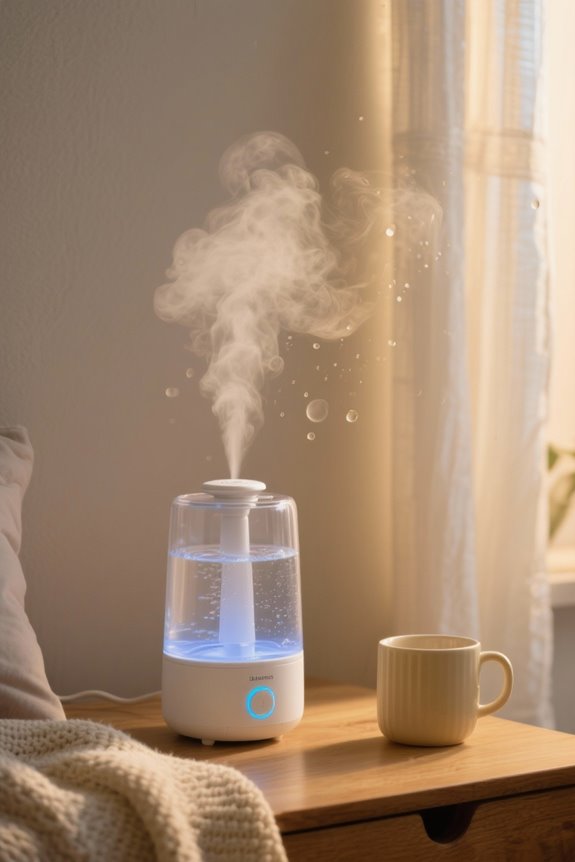
Mist formation in ultrasonic humidifiers relies on sophisticated physical processes that transform water into a fine mist. This begins with the cavitation process, where electrical energy generates ultrasonic vibrations, creating pressure variations in the water. These variations lead to the formation and rapid collapse of tiny vacuum bubbles, which tear water molecules from the bulk liquid. The transducer, typically a ceramic disc, creates compressions directed at the water surface, efficiently forming droplets. These droplets, measuring between 1 to 5 microns, quickly dissipate into the air due to reduced surface tension. The resultant droplet dynamics guarantee that the fine mist evaporates rapidly, increasing relative humidity while cooling the surrounding air, all without the need for heat or fans, making the process highly energy-efficient. Additionally, using essential oils in conjunction with these humidifiers can enhance the aromatherapy experience and promote relaxation.
Advantages of Ultrasonic Humidifiers

Ultrasonic humidifiers offer several considerable advantages that enhance their appeal for both personal and professional environments. These devices consume notably less electricity compared to steam humidifiers, promoting energy savings without sacrificing performance. Additionally, their operation is marked by impressive noise reduction, as they function almost silently, making them ideal for bedrooms or nurseries. The cool mist produced eliminates burn risks associated with steam models, increasing safety around children and pets. Maintenance is simplified since no wick or filter replacements are required, further reducing operating costs. Portability is guaranteed through compact designs, catering to space-constrained settings. Overall, ultrasonic humidifiers combine efficiency, safety, and convenience, making them a popular choice for improving indoor air quality. Furthermore, many models, such as the ASAKUKI Essential Oil Diffuser, also provide aromatherapy benefits, enhancing the overall atmosphere of your space.
Recommended Products

SMART HOME FEATURES: Monitor your air quality and adjust settings remotely using the SHARP AIR App. Compatible with Amazon Alexa and Google Assistant to allow voice control.

Optimized for your health: Rapidly purifies 1,875 sq ft in 1 hour, 391 sq ft every 12.5 minutes

Mist-free evaporative humidification for spaces up to 600 ft² including adjoining spaces that cannot be closed off such as hallways, lofts, and stairways. Based on standard 8-foot ceilings.
Comparing Ultrasonic and Other Humidifiers
When comparing different types of humidifiers, several key factors reveal the distinctive features that set ultrasonic models apart from their counterparts. Ultrasonic humidifiers operate quietly, producing noise levels below 30 decibels, making them ideal for bedrooms or offices. In contrast, evaporative humidifiers create more operational noise, ranging from 28 to 45 decibels. Additionally, ultrasonic units consume less electricity, promoting energy efficiency compared to energy-intensive steam humidifiers. Maintenance is simpler as they do not require frequent filter changes, whereas evaporative humidifiers necessitate regular filter replacements every 1 to 3 months. Hybrid humidifiers and smart humidifiers often combine features from different systems, but ultrasonic models remain unmatched in quiet operation, energy use, and maintenance, providing a reliable choice for humidification needs. These benefits make ultrasonic humidifiers a popular option for enhancing room comfort during colder months.
Recommended Products

Mist-free evaporative humidification for spaces up to 600 square feet including adjoining spaces that cannot be closed off such as hallways, lofts, and stairways. Based on standard 8-foot ceilings.

This 80 pint or 10 gallon humidifier is designed for up to 2,000 Sq. Feet of humidification

HEALTHIER AIR WITH WARM OR COOL MIST: Experience cleaner, more breathable air with Carepod humidifier's ultrasonic mist technology. Choose between warm or cool mist to alleviate dry skin, improve sleep, and enhance your wellness in rooms up to 700 sq. ft.
Practical Applications of Ultrasonic Humidifiers
Humidity control plays an essential role in various environments, influencing both comfort and health. Ultrasonic humidifiers demonstrate numerous humidifier benefits across healthcare, workplaces, and homes. In healthcare settings, they alleviate symptoms related to dry air, such as cracked lips and irritated eyes, while also enhancing respiratory function by maintaining moist nasal passages. In office spaces, these devices counteract dryness caused by air-conditioning, improving skin hydration and eye comfort. Their quiet operation makes them ideal for concentrated work environments. At home, ultrasonic humidifiers protect wooden furniture from damage due to low humidity and maintain air quality without raising temperatures. These practical applications highlight the importance of effective humidity control in enhancing overall well-being and comfort across various situations. Additionally, electric candle warmers complement ultrasonic humidifiers by creating a cozy atmosphere while diffusing pleasant scents throughout the space.
Recommended Products
HEALTHIER AIR FOR YOUR FAMILY: Help maintain comfortable humidity with a stainless steel humidifier. Enjoy clean, consistent mist that helps relieve dry skin, allergies, and poor sleep in every room.


HUMIDIFIER: Auto Mode monitors air quality and adjusts air purification and humidity levels.
Considerations for Use in Different Environments
Effective use of ultrasonic humidifiers requires careful consideration of the environments in which they operate. Environmental factors like humidity levels and mineral content in water can considerably affect indoor air quality. For instance, hard water can lead to higher aerosol particle concentrations and white dust accumulation. Air circulation plays a critical role, as poorly ventilated spaces may cause health implications due to increased particulate matter. Regular cleaning frequency is essential to prevent bacterial growth, especially in humid conditions. Noise levels are generally low, making these devices fit for bedrooms and offices. Usability features must include easy maintenance to guarantee peak performance, particularly in environments with varying mineral content and potential microbial risks. Additionally, monitoring optimal humidity levels is crucial to avoid over-saturation and maintain a healthy living space.
Recommended Products

【Commercial & Industrial Grade Humidifier】Household & Commercial Use. 26L/6.8Gal capacity and max 3000mL/h mist output, experience the difference with 4X humidification power. Large room humidifiers for home effectively humidify spaces covering up to 3000 sq ft, such as whole house, greenhouse, supermarket, warehouse, office, factory, etc. The ultrasonic cool mist humidifiers won't need any replacement filters to save your bill. Note: At first time to use, please take out the power cord, user manual & remote control inside the water tank.

【Commercial & Industrial Grade Humidifier】Household & Commercial Use. 26L/6.8Gal capacity and max 1800mL/h mist output, experience the difference with 4X humidification power. Large room humidifiers for home effectively humidify spaces covering up to 3000 sq ft, such as whole house, greenhouse, supermarket, warehouse, office, factory, etc. The ultrasonic cool mist humidifiers won't need any replacement filters to save your bill. Note: At first time to use, please take out the power cord, user manual & remote control inside the water tank.

Adjustable Humidity Levels:Customize and maintain the ideal humidity level for your plants. It offers 1-4 levels of fog volume and 35%-95% humidity adjustment.Flexible telescopic hoses ensure precise humidity distribution for specific areas or the entire grow space.
Importance of Water Quality in Ultrasonic Humidifiers
What role does water quality play in the functionality of ultrasonic humidifiers? Water quality greatly influences the efficiency and safety of these devices. Ultrasonic humidifiers utilize water to generate mist; consequently, the mineral content present directly affects air quality. Tap water often contains metals like arsenic and lead, which can become airborne as particulate matter, posing health risks, especially in poorly ventilated spaces. Children are particularly vulnerable due to higher doses deposited in their lungs. In contrast, using distilled water minimizes these issues, considerably reducing emissions of harmful substances. This choice improves indoor air quality while also preventing mineral dust accumulation on surfaces. Ultimately, maintaining high water quality is essential for both health and peak humidifier performance. Additionally, using filter-free designs helps ensure cleaner air and reduces maintenance needs for ultrasonic humidifiers.
Maintenance Tips for Optimal Performance
Proper maintenance is essential for ensuring peak performance in ultrasonic humidifiers. Users should implement regular cleaning schedules, emptying and rinsing the water tank daily to limit microbial growth. A deep clean every three days using a 50/50 vinegar and water solution effectively removes mold and mineral buildup. Before and after usage, a thorough clean is advisable, ensuring all components are completely dry. Maintenance tools, such as soft cloths or sponges, should be utilized, while avoiding abrasive materials that may cause scratches. Additionally, replacing antimicrobial components per manufacturer guidelines is vital for microbial control. Regular inspection of internal components helps sustain operational efficiency, thereby enhancing overall performance and longevity of the humidifier. Incorporating top-fill designs can further simplify the cleaning process and minimize mold growth.
Recommended Products


The Solution to Stubborn Grime: The Creworks 30L ultrasonic cleaner, equipped with 600W of power, a 600W heater, a timer, and a digital control panel, ensures effortless and thorough cleaning even in intricate and hard-to-reach areas

600W ULTRASONIC CAVITATION: This CREWORKS industrial ultrasonic cleaner uses 600W of power to fill its 7.9 gallon basin with cavitation bubbles, using the force of their tiny implosions to thoroughly and professionally clean even small and intricate surfaces; up to 600W of heating allows even more powerful action
Frequently Asked Questions
Can Ultrasonic Humidifiers Help With Allergies or Respiratory Issues?
Ultrasonic humidifiers can provide allergy relief and improve respiratory health by adding moisture to the air, soothing dry nasal passages, and potentially alleviating congestion. However, proper maintenance and humidity levels are essential to prevent adverse effects.
What Size Room Is Best for Ultrasonic Humidifiers?
Ideal room dimensions for ultrasonic humidifiers vary; small units suit spaces under 200 sq. ft., while medium models excel in 200-500 sq. ft. regions, harmonizing ideal humidity levels and preventing excess moisture accumulation.
How Often Should I Replace the Water in an Ultrasonic Humidifier?
Water in an ultrasonic humidifier should be replaced daily to adhere to frequency guidelines for water maintenance. This practice prevents bacterial growth and mineral buildup, ensuring efficient operation and promoting better respiratory health for users.
Are There Any Specific Brands Recommended for Ultrasonic Humidifiers?
Brand comparisons indicate that AIRCARE, Vicks, Honeywell, PureGuardian, and Vornado are recommended for ultrasonic humidifiers, each offering top features like whisper-quiet operation, customizable mist options, and ease of cleaning, catering to diverse user preferences.
Do Ultrasonic Humidifiers Require Any Special Types of Water?
Ultrasonic humidifiers require specific water types, preferably distilled water, to prevent mineral buildup. Using distilled minimizes maintenance needs and health risks associated with inhaling mineral particles, ensuring more efficient and healthier operation of the device.


