As an Amazon Associate, we earn from qualifying purchases. Some links on this site are affiliate links at no extra cost to you. Our recommendations are based on thorough research and editorial judgment.


Understanding CADR Ratings For Air Purifiers

CADR, or Clean Air Delivery Rate, measures the efficiency of air purifiers in removing specific pollutants, such as smoke, dust, and pollen, quantified in cubic feet per minute (CFM). The rating is determined through standardized testing in a controlled chamber, focusing on the removal rate of particles. Higher CADR ratings indicate better performance, particularly suited for room sizes, while ratings are pollutant-specific. Understanding CADR enables informed choices for improving indoor air quality; further insights await exploration.
Key Takeaways
- CADR measures an air purifier’s effectiveness in removing smoke, dust, and pollen, quantified in cubic feet per minute (CFM).
- Ideal CADR should equal two-thirds of the room’s area to ensure effective air purification.
- CADR ratings focus only on particulate pollutants, ignoring gases, odors, and bacteria.
- Consistent filter maintenance is essential for maintaining air purifier efficiency and overall air quality.
- Higher CADR ratings indicate better particle removal efficiency, crucial for larger rooms.
What Is CADR?
You may be interested


Clean Air Delivery Rate, commonly known as CADR, serves as a key metric for evaluating air purifiers. CADR significance lies in its ability to measure how effectively an air purifier removes specific airborne pollutants, quantifying the volume of clean air delivered per minute in cubic feet per minute (CFM). It focuses on three primary particle types: pollen, dust, and smoke. Each has a separate CADR value, reflecting varying filtration efficiencies. A common CADR misconception is that a higher rating always equates to overall effectiveness; however, CADR ratings are pollutant-specific. For ideal performance, the CADR rating should be at least two-thirds of the room’s floor area, ensuring adequate air purification for the intended space. Additionally, evaluating the CADR ratings for pathogens removal can help ensure that the air purifier is effective against viruses and other harmful microorganisms.
How CADR Ratings Are Determined
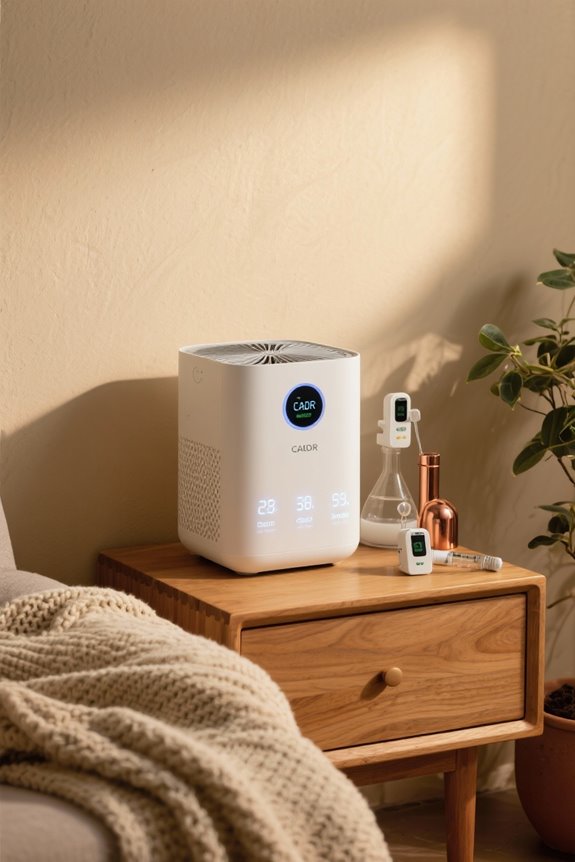
To accurately assess air purifiers, understanding how CADR ratings are determined is essential. CADR testing methodologies involve a sealed chamber, approximately 30 cubic meters, where controlled pollutants—dust, pollen, and tobacco smoke—are introduced. Each pollutant represents varying particle sizes, with tobacco smoke being the smallest and pollen the largest. During a 20-minute test, measurements are taken while a circulation fan operates, ensuring stable conditions. CADR is calculated by the removal rate of particles, multiplied by the chamber’s volume. This approach reflects both filter efficiency and airflow rate. The standardized methods set by the American Home Appliance Manufacturers (AHAM) aid in objectively comparing air purifiers, enabling consumers to make informed choices based on specific particle removal capabilities. Additionally, understanding the importance of high filtration rates can enhance the effectiveness of air purifiers in reducing allergens and pollutants.
The Importance of CADR in Air Purification

Understanding the importance of CADR ratings in air purification is critical for consumers seeking effective solutions for indoor air quality. CADR effectiveness is determined by measuring the clean air delivery rate in cubic feet per minute, allowing for direct CADR comparison among different air purifiers. Higher CADR ratings indicate the ability to remove pollutants—smoke, dust, and pollen—more quickly, thereby enhancing air quality rapidly. For larger spaces, purifiers with adequate CADR values guarantee proper air turnover, cleaning the air multiple times per hour. A recommended CADR should be at least two-thirds of the room’s area in square feet, allowing users to select models appropriate for their specific environments and pollutant challenges, ultimately maintaining a healthier indoor atmosphere. Additionally, considering HEPA filter efficiency is vital as it directly impacts the effectiveness of air purifiers in capturing airborne allergens and pollutants.
Understanding Pollutants: Smoke, Pollen, and Dust

Indoor air quality is greatly impacted by various pollutants, including smoke, pollen, and dust. Smoke particles, ranging from 0.1 to 1 micron, originate from sources like cooking and tobacco, making them challenging to capture effectively. Dust particles, sized between 0.5 and 3 microns, constantly circulate due to everyday activities and can aggravate respiratory issues. Pollen, larger in size (5-100 microns), enters homes seasonally, exacerbating allergen impacts for susceptible individuals. Effective air purifiers with high CADR ratings capture each pollutant type, ensuring cleaner air. HEPA filters are particularly efficient, targeting these specific sizes. Understanding pollutant sources and their characteristics is crucial for selecting appropriate air purification strategies, enhancing overall indoor air quality, and promoting better health outcomes. Incorporating air purifiers equipped with True HEPA filters maximizes the removal of harmful airborne particles, contributing to improved respiratory health.
Factors to Consider When Choosing CADR Ratings
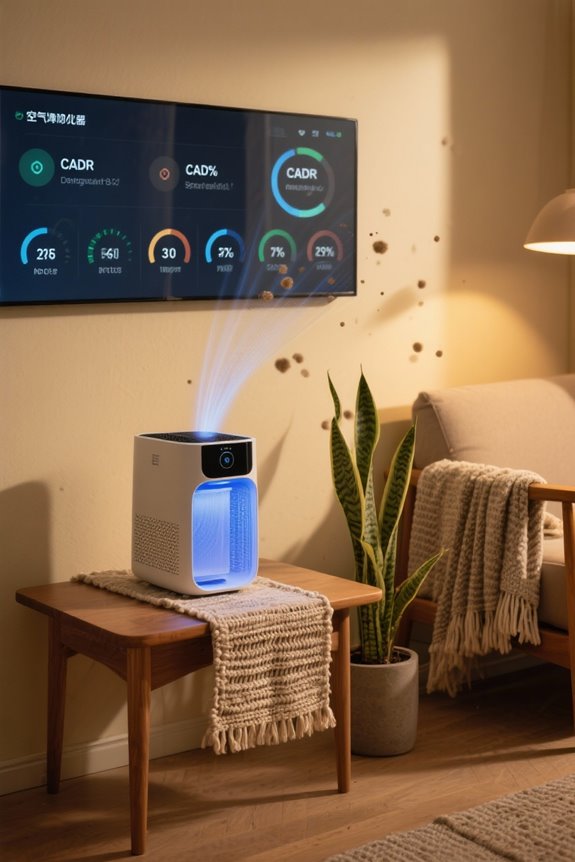
Choosing an air purifier with the right Clean Air Delivery Rate (CADR) rating is vital for effective air quality management, particularly when addressing specific room sizes and pollutant types. For instance, a 120 sq. ft. room should have a CADR of at least 80 CFM for smoke removal. It’s important to take into account pollutant diversity; CADR ratings reflect different filtration efficiencies for smoke, dust, and pollen, which vary in particle size from 0.1 to 100 microns. Larger rooms require proportionally higher CADR values, ensuring adequate air changes per hour. Selecting a unit that is too small may compromise air cleaning. Additionally, certification from AHAM provides assurance of meeting these standards, further supporting informed decisions in choosing the appropriate air purifier. Understanding filtration systems can greatly enhance your ability to select the most effective model for your needs.
New Developments in CADR Standards
Recent advancements in Clean Air Delivery Rate (CADR) standards reflect a significant evolution in air purifier technology, aimed at enhancing both performance and energy efficiency. Updated standards from ENERGY STAR, effective in 2026, mandate a PM2.5 CADR range between 30 and 600, ensuring clearer performance benchmarks. Additionally, specific energy efficiency thresholds, such as an Integrated Energy Factor (IEF) of 5.4 for 30–99 CADR units, promote reduced power usage while maintaining effective filtration. Regulatory influences, including California Air Resources Board (CARB) certifications, require safe ozone emissions and further impact CADR reporting practices. These thorough updates encourage manufacturers to balance performance metrics and design for improved functionality, ensuring cleaner indoor air while minimizing energy consumption. Furthermore, humidity management plays a crucial role in enhancing overall indoor air quality and can complement the effectiveness of air purifiers.
Real-World Applications of CADR Ratings
Effective air purification hinges on the application of Clean Air Delivery Rate (CADR) ratings, which serve as essential indicators for selecting the appropriate air purifier based on room size and specific pollutant types. CADR ratings guide users in matching purifiers to room dimensions by indicating air-cleaning speeds in cubic feet per minute. For instance, a 150-square-foot room ideally requires a smoke CADR of at least 100 CFM. These ratings reflect real-world effectiveness against specific pollutants like smoke, dust, and pollen. By understanding pollutant-specific CADR ratings, consumers can identify air purifiers tailored to their needs. Accurate room volume calculations facilitate adequate air changes per hour, enhancing practical applications for cleaner indoor air environments, such as homes and offices.
Limitations of CADR Ratings
Although Clean Air Delivery Rate (CADR) ratings serve as a valuable starting point for evaluating air purifier performance, they are not without significant limitations. The CADR focuses solely on particulate matter like smoke, pollen, and dust, leaving out the essential suppression of gases, odors, and VOCs. Furthermore, CADR scores do not indicate effectiveness against pathogens such as viruses and bacteria. Particle effectiveness can be inconsistent, especially for ultrafine particles below 0.3 microns, which are largely untested. Additionally, CADR ratings are based on short tests under ideal conditions, failing to account for real-world variables, such as room size and filter maintenance. This narrow scope of testing creates CADR limitations that may mislead consumers about overall air quality performance. Regular filter replacement is crucial for maintaining air quality performance, as it directly impacts the effectiveness of the air purifier.
The Role of AHAM Certification
The Clean Air Delivery Rate (CADR) ratings, while informative, may not provide complete assurance about an air purifier’s overall performance. The Association of Home Appliance Manufacturers (AHAM) plays an essential role through its certification process, which adheres to AHAM standards. This program verifies the accuracy of CADR values, as well as operating and standby power details, ensuring manufacturers provide reliable data. Independent third-party testing, performed by ISO/IEC 17025 accredited labs, confirms product performance under real-world conditions. In addition, ongoing compliance verification through random tests reinforces the integrity of the certification. The AHAM Verifide mark indicates that an air cleaner meets stringent performance criteria, offering consumers a trustworthy means to assess air purifiers in the marketplace. Moreover, high CADR ratings are crucial for effective performance in specific room sizes, further emphasizing the importance of AHAM certification in making informed choices.
Future Trends in Air Quality Management
How can advancements in technology and regulatory measures shape the future of air quality management? The integration of AI monitoring and machine learning enables real-time pollution pattern detection, enhancing proactive pollution control. Expanding IoT sensor networks provide continuous, high-resolution monitoring of various pollutants, improving data accuracy to inform decision-making. Additionally, advancements in filtration technologies optimize the removal of fine particles and gaseous pollutants, supporting healthier indoor and outdoor environments. Regulatory frameworks are tightening, driving demand for compliant air purification technologies, aligned with health-based National Ambient Air Quality Standards. International collaboration is also essential, addressing cross-border pollutant issues. As air quality management evolves, intelligent systems will better safeguard public health and the environment, highlighting the significance of merging technology with regulatory policies. Furthermore, the development of advanced filtration technologies enhances the effectiveness of air purifiers against various airborne contaminants.
Frequently Asked Questions
How Often Should I Replace My Air Purifier Filters?
Air purifier filters generally have a replacement frequency of 3 to 12 months, depending on filter type and usage. Users should monitor filter lifespan through performance indicators and visual checks for ideal air quality maintenance.
Can CADR Ratings Vary by Brand?
CADR ratings can vary by brand like stars in the night sky. CADR comparisons reveal significant brand differences, influencing performance and suitability for specific needs, underscoring the importance of careful brand selection in air purifier purchases.
Do CADR Ratings Apply to All Air Purifiers?
CADR ratings do not apply to all air purifier types. Their interpretation is relevant primarily for devices designed for particulate filtration, excluding units like ozone generators or those focusing solely on chemical filtration or microbial contaminants.
Are There Any Health Risks From Using Air Purifiers?
Like a double-edged sword, air purifiers can enhance air quality while posing health risks. Some devices emit ozone or volatile organic compounds, potentially exacerbating respiratory issues and negating their purported health benefits through adverse health effects.
How Can I Improve Air Quality Without an Air Purifier?
Improving air quality without an air purifier can be achieved through natural ventilation, such as opening windows, and incorporating indoor plants like peace lilies or spider plants, which effectively assist in purifying the air.


