As an Amazon Associate, we earn from qualifying purchases. Some links on this site are affiliate links at no extra cost to you. Our recommendations are based on thorough research and editorial judgment.


How HEPA Filters Work In Air Purifiers

HEPA filters in air purifiers utilize a dense fiber matrix to capture at least 99.97% of particles as small as 0.3 microns. This includes allergens, dust, and pathogens, which markedly enhances indoor air quality. They operate through mechanisms such as diffusion, interception, and impaction to efficiently remove harmful particles. Typically, HEPA filters should be replaced every 6 to 12 months for ideal performance. Understanding their structure and operation reveals vital insights into their effectiveness and benefits.
Key Takeaways
- HEPA filters use mechanical filtration with a dense fiber matrix to capture airborne particles as small as 0.3 microns with 99.97% efficiency.
- They utilize mechanisms like diffusion, interception, and impaction to effectively trap allergens, bacteria, and viruses in the air.
- In air purifiers, HEPA filters combine with other filters, like carbon, to capture both particles and gases, enhancing overall air quality.
- Filters must be replaced every 6 to 12 months to maintain efficiency and optimal airflow in air purification systems.
- Portable air purifiers with HEPA filters can significantly reduce indoor particulate matter, improving health outcomes for allergy and asthma sufferers.
Understanding HEPA Filters
You may be interested


HEPA filters, or High-Efficiency Particulate Air filters, are advanced air filtration systems designed to improve indoor air quality by capturing a wide range of airborne particles. They utilize mechanical filtration, featuring a dense matrix of fibers that create convoluted airflow pathways. This design enhances particle capture through three primary mechanisms: impaction, interception, and diffusion. The combination allows HEPA filters to trap particles as small as 0.3 microns with an impressive 99.97% efficiency. They effectively remove allergens, bacteria, and viruses, making them essential in health-sensitive environments. As innovative filtration technologies evolve, future filter advancements may incorporate electrostatic attraction and multi-layer designs, further enhancing their capabilities in creating healthy indoor spaces, safeguarding against pollutants, and improving public health outcomes. Additionally, HEPA filters are notable for their ability to capture allergens, which significantly enhances overall indoor air quality in households, particularly those with pets.
Materials Used in HEPA Filters
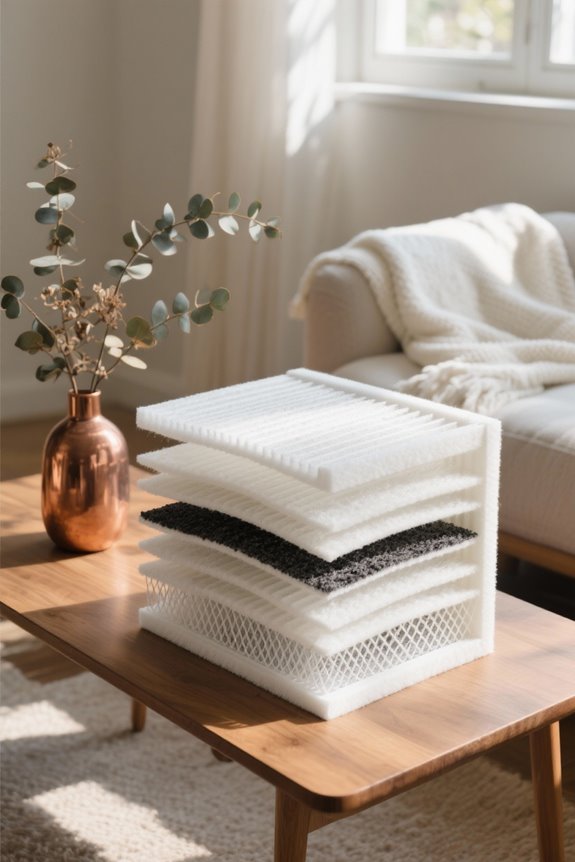
When selecting materials for HEPA filters, manufacturers prioritize efficiency, durability, and performance. The most common fiber types include glass fibers, which dominate due to their small diameter and high filtration performance. Melt-blown borosilicate glass fiber pleated paper is typically used in industrial units. Polypropylene (PP) fibers, created through a hot-melt process, provide resistance to acids and corrosion and can meet the highest HEPA grades (H14). Polyester (PET) fibers offer high hardness and temperature resistance but are generally rated lower (H10–H11). Manufacturers often combine PP and PET to enhance filter strength. Additionally, synthetic fibers may be blended with glass fibers to optimize durability while maintaining filtration performance. Each fiber type contributes uniquely to the overall effectiveness of the HEPA filter. Furthermore, True HEPA filters are essential for capturing particles down to 0.1 microns, crucial for virus protection.
Structure and Design of HEPA Filters

The design of HEPA filters plays a vital role in their performance and efficiency. Constructed from multi-layer mats of extremely fine fibers, typically glass, these filters feature a complex structure that enhances filtration capacity. Fiber diameters range from 1 to 10 micrometers, allowing for effective particle capture through airflow dynamics rather than simple sieving. The pleated design increases the effective surface area while maintaining a compact size, which maximizes air passage through the filter. Corrugation parameters, such as height and angle, affect airflow resistance; ideal values minimize pressure drop while maintaining filtration efficiency. This balance is essential, as higher resistance necessitates stronger fans in air purifiers, ensuring proper circulation without compromising energy efficiency. Additionally, the HEPA filtration system is crucial for capturing a wide range of pollutants, including smoke and allergens, ensuring cleaner indoor air quality.
How HEPA Filters Capture Particles

Air filtration depends considerably on various mechanisms that enable filters to capture particles of differing sizes. HEPA filters utilize diffusion, interception, and impaction to achieve remarkable filtration efficiency. For particles smaller than 0.1 µm, erratic Brownian motion enhances their likelihood of contact with filter fibers, allowing effective capture, especially viruses and combustion aerosols. Meanwhile, mid-sized particles between 0.1 and 1.0 µm can be intercepted through molecular adhesion forces, ensuring they stick upon contact. Larger particles, greater than 0.5 µm, experience inertial impaction, deviating from airflow and colliding with fibers. The combined action of these mechanisms allows HEPA filters to achieve a minimum efficiency of 99.97% for particles measuring down to 0.3 µm, covering a broad range of particle sizes effectively. Additionally, models with activated carbon filters can further enhance odor removal and overall air quality.
Mechanisms of Filtration

Understanding the mechanisms of filtration reveals how HEPA filters efficiently capture a variety of airborne particles. These filters utilize mechanical structures made from fibers, often polypropylene or fiberglass, with diameters of 0.5 to 2 microns. The dense, tortuous pathways increase filtration efficiency by forcing air to navigate around the fibers. Larger particles, typically above 0.5 microns, are captured through inertial impaction, deviating from airflow and colliding with fiber surfaces. Medium-sized particles, ranging from 0.1 to 0.5 microns, are captured via interception, while submicron particles benefit from diffusion due to their erratic motion. Additionally, electrostatic attraction enhances particle dynamics, allowing for improved capture without appreciably increasing air resistance, making HEPA filters highly effective for various airborne pollutants. The effectiveness of HEPA filters is demonstrated by their ability to capture 99.97% of airborne particles, ensuring cleaner air quality in residential and commercial spaces.
Efficiency Standards for HEPA Filters
HEPA filters are distinguished by their rigorous efficiency standards, essential for ensuring high air quality in various environments. To earn certification, these filters must achieve a minimum of 99.97% efficiency at 0.3 microns, as outlined by industry standards in the United States. European standards, such as EN 1822:2019, classify filters based on their Most Penetrating Particle Size (MPPS), typically between 0.1 and 0.3 microns, which is where filtration can be most challenging. Certification requires individual testing to confirm compliance with these performance metrics, ensuring that filters effectively capture particles. Classifications include H13 and H14, which indicate efficiencies of 99.95% and 99.995%, respectively, affirming their suitability for critical applications like cleanrooms and laboratories. Additionally, many modern air purifiers incorporate advanced filtration technology to enhance their effectiveness in removing a broader range of airborne pollutants.
Importance of Certification
Certification holds significant importance in the context of HEPA filters, impacting both air quality and safety in various environments. The certification process guarantees that HEPA filters meet rigorous global standards, such as EN1822 and ISO 29463, which mandate specific efficiency ratings by testing particles at the most penetrating particle size (MPPS). Filters achieving these certifications must demonstrate a minimum removal efficiency of 99.95% to 99.995%, confirming high filter integrity. Additionally, individual unit certification is critical, as it verifies that each filter performs consistently to prevent air quality variability. Leak tests and post-installation assessments further guarantee that filters remain intact after handling. Overall, certified HEPA filters represent a commitment to both efficiency and safety in air purification applications, reinforcing environmental health standards. Furthermore, certified HEPA filters are essential for allergy sufferers, as they capture particles as small as 0.3 microns with 99.97% efficiency.
Applications of HEPA Filters
Applications of HEPA filters are diverse and essential across various sectors, highlighting their importance in enhancing air quality. In medical and healthcare facilities, HEPA filters maintain sterile environments by removing harmful pathogens, thereby protecting immunocompromised patients. They also comply with strict manufacturing standards in pharmaceutical clean rooms, ensuring air purity during production processes. In residential settings, HEPA filters greatly reduce allergens such as dust and mold, improving indoor air quality for asthma and allergy sufferers. In industrial uses, these filters protect sensitive processes like electronics manufacturing by maintaining low particle counts. Finally, in transportation, HEPA filters enhance air quality in airplanes and public transit systems, reducing airborne pollutants for healthier environments. Additionally, models like the H13 true HEPA filter are specifically designed to capture 99.97% of airborne particles, making them particularly effective for allergen reduction.
Recommended Products

3-pack filter replacement bundle: Genuine replacement filters from IQAir! Designed for our advanced HealthPro Plus room air purifiers, this 3-pack 3-in-1 IQAir filter bundle includes three long-lasting replacement filters: PreMax Pre-Filter, V5-Cell Gas and Odor Control Filter, and HyperHEPA Filter.

WHOLE-HOME AND EXTRA LARGE ROOM COVERAGE Designed for open floor plans and whole-home air purification. Rapidly cleans 1,043 ft2 in 15 minutes & up to 4,172 ft2 in 1 hour, delivering consistent purification where you sleep, work, and relax.

5-Pack HEPA Replacement Filter: Genuine HyperHEPA replacement for IQAir HealthPro Series Air Purifiers
Health Benefits of Using HEPA Filters
Air quality greatly impacts overall health, with advancements in filtration technology, like HEPA filters, providing tangible benefits. HEPA filters demonstrate superior filter performance, capturing airborne allergens, fine particulate matter (PM2.5), and irritants. Clinical studies indicate that using HEPA air purifiers considerably lowers systolic blood pressure, reducing cardiovascular disease risks. Portable devices can decrease indoor PM2.5 by over 50%, addressing respiratory irritation and improving lung health. In addition, HEPA filtration alleviates allergy and asthma symptoms, leading to better sleep quality by minimizing nighttime respiratory discomfort. The Environmental Protection Agency reviewed multiple studies, confirming that HEPA air cleaners yield measurable health impacts, contributing to overall well-being by creating cleaner indoor air environments essential for respiratory health. Moreover, advanced features like real-time air quality monitoring in air purifiers ensure that users maintain optimal indoor air conditions.
The Role of HEPA Filters in Air Purifiers
HEPA filters play an essential role in air purifiers by providing highly effective particulate matter removal, which enhances indoor air quality. These filters capture particles as small as 0.3 microns with a minimum efficiency of 99.97%, ensuring ideal filter performance. By utilizing mechanisms such as impaction, interception, and diffusion, HEPA filters excel in trapping a variety of airborne contaminants, including dust, pollen, and mold spores. They are designed from a dense matrix of fibers, maximizing surface area for superior purification efficacy. The integration of HEPA filters within air purifiers allows for multi-stage filtration systems, which greatly improve indoor environments. Reliable HEPA filters are vital for allergy and asthma sufferers, as they efficiently eliminate key irritants from the air. Additionally, many air purifiers for pet owners feature advanced filtration systems that combine HEPA technology to target pet-related pollutants.
Recommended Products

Advanced HyperHEPA Filtration: Designed to remove and trap 99.995% of all airborne particles down to 0.003 microns, the Atem X supplies unequaled protection against dust, pollen, pet dander, smoke from wildfires, and more. True HEPA filtration

3-Stage Filtration System: AlorAir Cleanshield HEPA 550 Air Scrubber build with Airflow 270-550 CFM with Variable Speed as a portable HEPA air purifier. It can be used with up to 3 levels of filtration, pre-filters, activated carbon/HEPA filters.

Air Flow Process in Air Purifiers
In the process of purifying indoor air, the circulation mechanism within air purifiers plays an important role. Air flow dynamics are initiated when the purifier draws in polluted air through side or rear intake ports using fans. These designs guarantee proper circulation efficiency, directing clean air out through top outlet vents. Effective air flow is vital, as it allows for best filtering, especially in single-room applications. Larger particles settle by gravity, while smaller particles are captured through mechanisms like diffusion and inertial impaction. With multiple filter stages, including HEPA filters that capture 99.97% of pollutants down to 0.3 micrometers, consistent air flow enhances overall purification effectiveness. Higher air flow rates lead to more impressive purification outcomes in various environments.
Recommended Products

4-STAGE FILTRATION FOR CLEANER AIR - Featuring a filter with integrated Activated Carbon and Zeolite, this air purifier captures airborne particles, including dust, pollen, pet dander, mold, smoke, and VOCs, offering a healthier, cleaner environment for your home or office.

INDUSTRY-LEADING CLEANING POWER - iAdaptAir has one of the highest clean air delivery rates (CADR) on the market: Pro size boasts 706 CFM. Covers 5,474 sq. ft. in one hour or 1,059 sq. ft. with 5 air exchanges per hour.
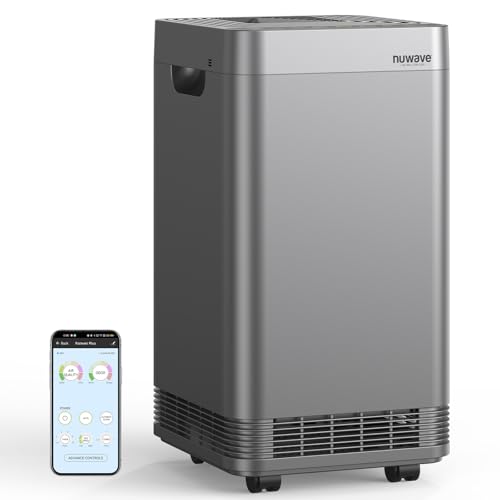
NEVER REPLACE AIR FILTER SYSTEM – Save money and reduce waste with the Forever Plus air purifier with washable filters. No need for costly replacements—just wash and reuse, eliminating the hassle of paper filters while keeping your air fresh and clean.
Maintenance and Replacement of HEPA Filters
Regular maintenance of HEPA filters is essential for sustaining air quality and ensuring efficient performance. Manufacturers typically recommend replacing HEPA filters every 6 to 12 months, depending on specific model features and usage conditions. Carbon prefilters require more frequent replacement, generally every three months. Replacement indicators, such as increased airflow resistance or visible dirt accumulation, should not be solely relied upon, as filters may appear clean while still harboring microscopic particles that reduce effectiveness. Gentle vacuuming can extend filter longevity by removing loose debris. Washing non-washable HEPA filters is not advised, as it can damage fibers. Proper handling and thorough air drying for washable filters are critical to maintain their efficiency and prevent mold growth.
Recommended Products
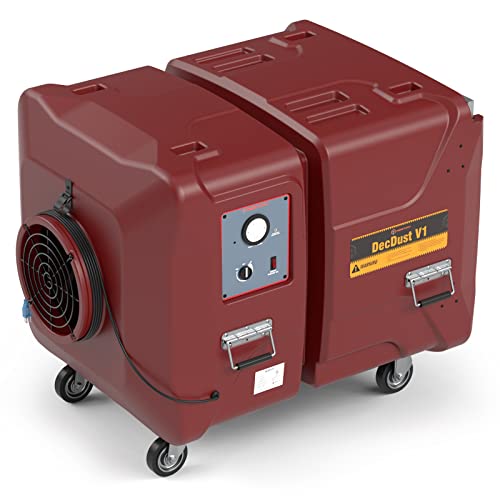
Multiple Filtration - DecDust V1 Air scrubber with 2-in-1 filter system, used with pre-filter, HEPA filter which captures 99.97% of 0.3-micron airborne particles such as smoke, pet dander, wood chips, and debris allergens, etc. Heavy-duty air scrubbers are ideal for use in large commercial spaces to improve air quality.

5-pack filter replacement bundle: Genuine replacement filters from IQAir! Designed for our advanced HealthPro Plus room air purifiers, this 5-pack 3-in-1 IQAir filter bundle includes three long-lasting replacement filters: PreMax Pre-Filter, V5-Cell Gas and Odor Control Filter, and HyperHEPA Filter.
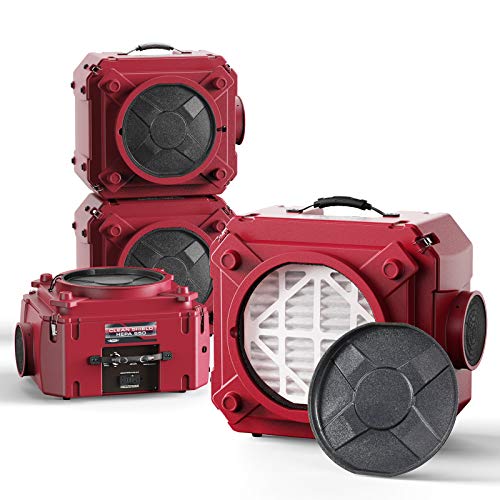
Clean air anywhere: ALORAIR Cleanshield HEPA 550 Air Scrubber build with Air flow 270-550 CFM with Variable Speed as a portable HEPA air scrubber.
Comparing HEPA Filters With Other Filter Types
When comparing air filtration systems, efficiency and particle capture ability emerge as critical factors. HEPA filters, renowned for their performance, capture at least 99.95% of particles sized 0.3 microns and above, outperforming MERV 13 filters which have lower efficiency ratings. In a filter efficiency comparison, HEPA filters are rated MERV 17 or higher and are commonly used in hospitals for their ability to trap pathogens. In contrast, activated carbon filters excel at capturing gases and odors but inadequately address particulate matter. Furthermore, filtration costs can vary remarkably, with high-end HEPA filters offering superior construction and sealing. Air quality analysis shows that the combined use of HEPA and carbon filters can enhance indoor environments by addressing both particles and gases effectively.
Recommended Products

1 of Coway Airmega 400 in Graphite/Silver Smart Air Purifier with 1,560 sq. ft. Coverage


Environmental Impact of HEPA Filters
The environmental impact of HEPA filters extends beyond their impressive particle capture capabilities. While they notably improve indoor air quality, the waste generated by replaced filters poses serious concerns. Most HEPA filters are made from non-biodegradable materials and are rarely recyclable, leading to millions ending up in landfills annually in the U.S. The production process of these filters requires substantial resources and emits greenhouse gases, contributing to their lifecycle impact. Filter innovation, such as reusable or washable options, shows potential for enhancing sustainability practices by reducing waste. However, the balance between health benefits from improved air quality and the environmental trade-offs of energy usage remains vital. Sustainable alternatives continue to emerge, yet the predominant disposable model challenges effective resource management.
Frequently Asked Questions
How Long Do HEPA Filters Last Before Needing Replacement?
HEPA filters typically have a lifespan of 6 to 12 months, necessitating regular replacement frequency for ideal air quality. Factors like usage, air pollution, and filter quality greatly influence their overall longevity and effectiveness.
Do HEPA Filters Help With Odors and Smoke?
HEPA filters primarily excel in smoke filtration, capturing fine particulate matter. However, they do not contribute effectively to odor reduction, necessitating the use of complementary activated carbon filters for thorough smoke and odor management in indoor environments.
Can HEPA Filters Remove Viruses From the Air?
HEPA filters effectively remove viruses from the air, enhancing air quality by trapping infectious particles. In contrast, virus transmission persists without proper filtration, highlighting the importance of these filters in maintaining a healthier indoor environment.
Are HEPA Filters Safe for Homes With Pets?
HEPA filters are safe for homes with pets, effectively capturing pet allergens without harming animals or humans. Regular filter maintenance is essential to guarantee peak performance and maintain indoor air quality in pet-friendly environments.
What Is the Cost Difference Between HEPA and Other Filters?
When it comes to cost comparison, HEPA filters typically range from $20 to $200, offering superior filter efficiency. In contrast, activated carbon and washable filters involve higher long-term expenses due to frequent replacements, eating into savings.


