As an Amazon Associate, we earn from qualifying purchases. Some links on this site are affiliate links at no extra cost to you. Our recommendations are based on thorough research and editorial judgment.


Do Air Purifiers Remove Smoke And Odors

Air purifiers can remarkably reduce smoke and odors in indoor spaces. They employ HEPA filters, which capture at least 99.97% of particles as small as 0.3 microns, and activated carbon filters, which effectively adsorb VOCs and odors. However, challenges exist, as some smoke particles can escape typical filtration systems, and certain gases, like carbon monoxide, are not eliminated. Effective smoke odor removal often requires additional cleaning methods and strategic purifier placement. More details about optimizing air quality and selecting suitable devices can be found below.
Key Takeaways
- Air purifiers with HEPA filters effectively capture fine smoke particles but do not remove odors from smoke.
- Activated carbon filters excel at trapping odors and harmful gases, making them essential for smoke odor removal.
- Smoke odors can persist as they absorb into fabrics and surfaces, requiring more than just air purification for complete elimination.
- HEPA filters ensure clean air by trapping allergens, while activated carbon filters manage volatile organic compounds (VOCs) associated with smoke.
- Regular maintenance of filters and strategic placement near pollution sources enhance air purifier efficiency for smoke and odor reduction.
Understanding Smoke and Odor Composition
You may be interested


Smoke presents a complex mixture of gases and particulate matter that results from the combustion of organic materials, such as wood and tobacco. This smoke chemistry encompasses various harmful compounds, including polycyclic aromatic hydrocarbons (PAHs) and volatile organic compounds (VOCs), which can produce a variety of odor components. Importantly, phenols and hydrogen sulfide contribute to the characteristic smells associated with smoke, while aldehydes like formaldehyde add pungent notes. In addition, the particulate matter includes fine particles, which can remain suspended in the air for extended periods, posing health risks. Wood smoke alone accounts for about 35% of fine particle pollution in certain regions, highlighting the significant impact of smoke composition on both odor and health. Many air purifiers designed for pet owners also effectively neutralize smoke odors, making them a valuable addition to homes with pets.
How Air Purifiers Work
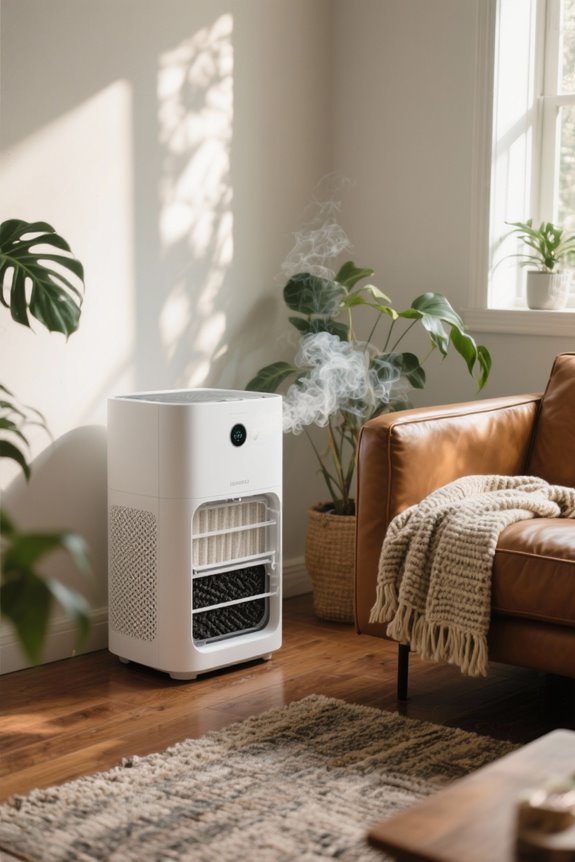
Air purifiers are essential devices that substantially enhance indoor air quality by removing a variety of pollutants. They primarily operate through air circulation, drawing in air via built-in fans, which create a smooth flow. This air then passes through multiple filtration stages, starting with pre-filters that capture larger particles. Following this, activated carbon filters absorb volatile organic compounds and unpleasant odors, while HEPA filters showcase impressive filter efficiency by removing up to 99.95% of particles as small as 0.1 microns. Some models include sensors to optimize performance by detecting pollution levels. Each component is designed to maximize airflow and guarantee thorough filtration, greatly improving indoor air conditions in both residential and commercial spaces. Additionally, True HEPA filters are crucial for effectively capturing airborne viruses and allergens, ensuring a healthier living environment.
Importance of HEPA Filters

HEPA filters play a pivotal role in enhancing indoor air quality, particularly by targeting airborne allergens and harmful particulates. With HEPA filter efficiency rated to capture at least 99.97% of particles as small as 0.3 microns, they effectively trap allergens like pollen, pet dander, and mold spores. These filters also considerably reduce smoke particulates, including PM2.5, which are linked to serious health risks. The rapid removal of these airborne particles improves indoor air quality, providing immediate relief, especially for allergy and asthma sufferers. While HEPA filters excel in removing particulate matter, they do not neutralize odors. Consequently, combining HEPA filtration with other technologies is essential for addressing both particulates and gaseous pollutants in indoor environments effectively. Additionally, air purifiers with washable pre-filters can extend the life of HEPA filters and reduce maintenance costs.
Recommended Products

MOOKA B-D02L AIR PURIFIER FOR LARGE ROOM: With the high-efficiency filtration system, the air purifier covers an area up to 1076 ft². 6 air changes per hour in 215 ft², 1 air changes per hour in 1076 ft². Modern design fits in any space from small to large rooms, bedrooms, living rooms, offices, nurseries, kitchens and basements. Perfect for pet owners, babies, children, the elderly, or anyone wanting to improve the air quality

𝗪𝗛𝗬 𝗖𝗛𝗢𝗢𝗦𝗘 𝗔𝗛𝗔𝗠 𝗩𝗘𝗥𝗜𝗙𝗜𝗗𝗘 𝗔𝗜𝗥 𝗣𝗨𝗥𝗜𝗙𝗜𝗘𝗥𝗦: AHAM (Association of Home Appliance Manufacturers) is an ANSI-accredited organization that sets strict standards for appliance performance. Air purifiers with the AHAM VERIFIDE seal have been independently tested for air cleaning performance, safety, and energy efficiency. When you choose an AHAM certified air purifier, you're choosing a product trusted for reliable and effective indoor air quality improvement

MOOKA B-D02L AIR PURIFIER FOR LARGE ROOM: With the high-efficiency filtration system, the air purifier covers an area up to 1076 ft². 6 air changes per hour in 215 ft², 1 air changes per hour in 1076 ft². Modern design fits in any space from small to large rooms, bedrooms, living rooms, offices, nurseries, kitchens and basements. Perfect for pet owners, babies, children, the elderly, or anyone wanting to improve the air quality
The Role of Activated Carbon Filters

Activated carbon filters serve as an essential complement to air purification systems, particularly in environments affected by odors and harmful gases. These filters utilize a porous structure that enhances their ability to trap pollutants through an adsorption process. They are highly effective at removing odors, including smoke, pet smells, and cooking fume, making them vital for pollution reduction. Activated carbon captures volatile organic compounds (VOCs), which contribute to indoor air pollution, outperforming standard particle filters like HEPA. Their long lifespan allows for continued effectiveness over time. In various settings, from homes to restaurants, activated carbon filters maintain fresh air by neutralizing odors and absorbing chemicals, enhancing overall air quality and contributing to healthier indoor environments. Additionally, many air purifiers, such as the WINIX 5510, incorporate activated carbon filters to maximize odor removal capabilities.
Recommended Products

Why Choose the AirHub Air Purifier? AHAM VERIFIED Performance: Certified by the Association of Home Appliance Manufacturers (AHAM), this air purifier has been independently tested to rigorous industry standards for dust, smoke, and pollen removal. With verified CADR ratings, it delivers 4.8 ACH in a 209 ft² room, covers up to 1,092 ft² with 1 ACH. Designed to help improve indoor air quality, it is a trusted, reliable, and professional air purifier for home.

𝐀𝐇𝐀𝐌 𝐕𝐞𝐫𝐢𝐟𝐢𝐞𝐝 & 𝐇𝐢𝐠𝐡 𝐂𝐀𝐃𝐑 𝐕𝐚𝐥𝐮𝐞: Certified by the Association of Home Appliance Manufacturers, this air purifier provides reliable performance with a Smoke/Dust/PM2.5 CADR of 226 CFM (384 m³/h) and a Pollen CADR of 244 CFM (415 m³/h). AHAM certification guarantees effective, high-speed air purification for your home.
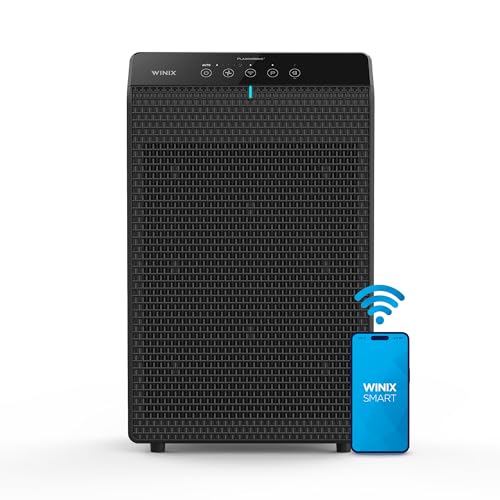
𝐀𝐇𝐀𝐌 𝐕𝐞𝐫𝐢𝐟𝐢𝐝𝐞 𝐚𝐭 𝟑92 𝐬𝐪 𝐟𝐭.: Also cleans rooms up to 1,882 sq ft in 1 hour (941 sq ft in 30 minutes, 627 sq ft in 20 minutes, 470 sq ft in 15 minutes)
Advanced Filtration Technologies

The landscape of air purification is markedly enhanced by advanced filtration technologies that offer improved air quality for various environments. HEPA filters, renowned for their filtration efficiency, capture 99.97% of particles as small as 0.3 microns, effectively removing smoke and allergens. UltraHEPA filters further improve this performance by capturing particles as tiny as 0.003 microns. Complementing these are UV-C light and activated oxygen systems, which inactivate airborne pollutants, contributing to cleaner air. Multi-stage filtration systems combine these technologies, ensuring thorough air cleaning. Additionally, specialized filters, such as VOC filters, target volatile organic compounds, enhancing overall effectiveness. These innovations signify a significant shift toward more effective air quality management in both residential and commercial settings, ultimately supporting better health. Moreover, advanced filtration technologies like the 2X-Power Filtration system found in the HAP603 air purifier provide air purification twice every hour, which is crucial for maintaining optimal air quality.
Challenges of Smoke Odor Removal
Removing smoke odors poses significant challenges, even with advanced air purification technologies. Odor persistence is a major issue, as smoke odors infiltrate fabrics, carpets, and walls, which absorb and later release these smells into the air. Standard air purifiers target airborne particles but do not adequately address surface absorption, leaving lingering scents unremedied.
In addition, cigarette smoke particles range from 0.1 to 1.0 microns, with ultrafine particles often escaping conventional filters. Even the best HEPA technology can fail to capture these minute particles. Moreover, while activated carbon filters can adsorb many volatile organic compounds (VOCs), they have limitations, as some gases, like carbon monoxide, remain unfiltered. Consequently, thorough odor removal often requires additional cleaning measures beyond air purification alone. Additionally, the effectiveness of air purifiers can be enhanced with True HEPA filters, which capture 99.97% of airborne particles, improving overall air quality.
Key Features of Effective Air Purifiers
Effective air purifiers incorporate several key features that enhance their ability to improve indoor air quality, particularly in environments affected by smoke. High filter efficiency is critical, with True HEPA filters capturing 99.97% of particles as small as 0.3 microns, effectively addressing smoke particulate matter. The integration of activated carbon filters aids in adsorbing smoke odors and volatile organic compounds. Larger carbon filters, weighing several pounds, extend filter life while improving odor removal. Air circulation is also essential; powerful fans increase the Clean Air Delivery Rate, optimizing speed for smoke reduction, often achieving zero PM1 levels within 30 minutes. Combining these features results in a robust purifier capable of tackling both particulates and odors efficiently. Additionally, HEPA filtration systems are particularly effective in capturing a wide range of airborne allergens and pollutants, enhancing overall indoor air quality.
Recommended Products

𝐀𝐇𝐀𝐌 𝐕𝐞𝐫𝐢𝐟𝐢𝐞𝐝 & 𝐇𝐢𝐠𝐡 𝐂𝐀𝐃𝐑 𝐕𝐚𝐥𝐮𝐞: Certified by the Association of Home Appliance Manufacturers, this air purifier provides reliable performance with a Smoke/Dust/PM2.5 CADR of 226 CFM (384 m³/h) and a Pollen CADR of 244 CFM (415 m³/h). AHAM certification guarantees effective, high-speed air purification for your home.

4-in-1 filter includes pre-filter layer and a combination of an activated carbon and high efficiency filter for 99 % of 0.1 micron particles or larger on sleep mode including pollen dust smoke and dander

【Size Notice】Our replacement filter is specially designed for the VOOPNU JH12 air purifier and measures 5.12in × 5.12in × 3.62in, identical to the original filter included with the unit. A tolerance of about ±0.04in (1mm) may occur, but this does not affect performance. After installation, you may notice a small gap between the filter and the frame—this design helps guide airflow through the filter core, enhancing purification efficiency
Sizing and Positioning Your Air Purifier
Determining the right size and positioning for an air purifier is essential for maximizing its performance and ensuring ideal indoor air quality. Measuring the room’s volume, calculated by multiplying length, width, and height, informs the necessary Clean Air Delivery Rate (CADR). Ideally, the CADR should equal at least two-thirds of the room’s square footage, ensuring effective air cleaning. For best airflow optimization, strategically placing the purifier near pollution sources, and away from walls or furniture, enhances its efficiency. Elevating the unit off the ground aids circulation. In larger spaces, multiple purifiers may be necessary, positioned evenly to cover all areas, meeting specific needs based on occupancy levels and activities, thereby improving overall air quality considerably. It’s also important to consider the filtration efficiency of the air purifier to ensure it effectively removes smoke and odors from the environment.
Recommended Products

WHY CHOOSE AHAM VERIFIDE AIR PURIFIERS: AHAM (Association of Home Appliance Manufacturers) is an ANSI-accredited organization that sets strict standards for appliance performance. Air purifiers with the AHAM VERIFIDE seal have been independently tested for air cleaning performance and energy efficiency. When you choose an AHAM certified air purifier, you're choosing a product trusted for reliable and effective indoor air quality improvement

Effortless Operation: Simplified control panel with intuitive design makes it easy to operate. No complicated setup—just one tap, and you're on your way to cleaner air, saving time and letting you relax with ease
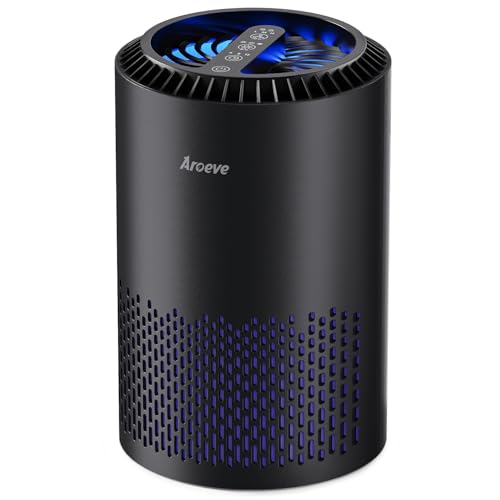
Impressive Particle Filtration: AROEVE air purifier utilizes filter that can filter out particles such as smoke, pollen, dander, hair, and more, potentially improving air quality and promoting better health and well-being for you.
Maintenance and Filter Replacement
Regular maintenance and timely filter replacement are vital for optimizing air purifier performance, especially in smoke-heavy environments. HEPA filters should be inspected every 1–3 months, with replacement necessary if discoloration or reduced airflow occurs. Activated carbon filters typically have a lifespan of 3–6 months, depending on smoke exposure. Monthly checks are advised for pre-filters, which capture large debris. Smart air purifiers may include indicators that signal when filters require changing. Following manufacturer guidelines is important for maintaining efficiency. Users should handle filters carefully during replacement and note installation dates for tracking. Spare filters can alleviate downtime and guarantee consistent performance. An increase in noise or a persistent smoke odor often signifies that filters need attention. Regular filter replacement ensures that the air purifier effectively captures fine particulates and maintains high air quality.
Health Implications of Smoke Exposure
Smoke exposure poses significant health risks to individuals, influencing both immediate and long-term health outcomes. Secondhand smoke (SHS) contributes to nearly 34,000 heart disease deaths annually among nonsmokers, raising coronary heart disease risk by up to 30%. Brief exposure can damage blood vessels, increasing the risk of heart attacks. Wildfire smoke, containing fine particulate matter (PM2.5), links to a 70% increased risk of out-of-hospital cardiac arrests during severe events. In addition, SHS exposure leads to respiratory issues, such as asthma exacerbations and increased hospitalizations for respiratory infections. It also accounts for approximately 7,300 lung cancer deaths each year in the U.S. Clearly, the health risks associated with smoke exposure are profound and necessitate serious consideration for public health. Many air purifiers are designed to neutralize smoke and odors, helping to improve indoor air quality for those affected by smoke exposure.
Choosing the Right Air Purifier
Addressing the health implications of smoke exposure calls for practical solutions, one of which is the use of air purifiers. Choosing the right model involves evaluating features that affect air quality and filter efficiency. True HEPA filters capture 99.97% of particles ≥0.3 microns, essential for removing smoke particulates, while activated carbon filters effectively adsorb odors, including smoke smells. Hybrid purifiers, combining both technologies, offer extensive solutions. The Clean Air Delivery Rate (CADR) indicates how quickly a purifier can eliminate smoke particles; higher ratings denote faster performance. Additionally, compatibility with room size and third-party certifications validate claims about capacity and effectiveness. Regular maintenance and awareness of filter replacement costs also influence the long-term viability of air purifier investments.
The Limitations of Air Purifiers
Although air purifiers are often regarded as effective solutions for improving indoor air quality, their limitations are significant factors to contemplate. HEPA filters capture 99.97% of particles 0.3 microns or larger, yet they do not remove gases or volatile organic compounds (VOCs), which often contribute to persistent smoke odors. Activated carbon filters can capture VOCs but may become saturated quickly, leading to efficiency challenges if not replaced frequently. In addition, even advanced systems like PECO may not be universally available or affordable and can consume more energy. Air purifiers also require strategic placement near odor sources and may not fully eliminate lingering odors, necessitating additional measures like ventilation and surface cleaning for thorough remediation.
Alternative Methods for Smoke Odor Remediation
Effective remediation of smoke odors requires a multifaceted approach that combines various methods to achieve ideal results. Ventilation optimizes airflow, allowing smoke particles to disperse and reducing odor concentration. For effective use of natural deodorizers, activated charcoal and baking soda are effective; activated charcoal should be replaced every three weeks, while baking soda can be left on surfaces for days before vacuuming. Deep cleaning also plays a significant role; washing walls and floors with hot water and detergent removes residues. For fabrics, professional cleaning may be necessary to eliminate embedded odors. Additional techniques like applying odor-sealing primers or using essential oils in diffusers further enhance remediation efforts, creating a more pleasant indoor environment.
Frequently Asked Questions
Can Air Purifiers Eliminate Smoke Odors Permanently?
Air purifiers cannot provide permanent solutions for smoke odors, akin to a bandage on a wound. While they enhance odor absorption, embedded residues require deep cleaning and preventive measures for lasting freshness in the environment.
How Long Does It Take for Air Purifiers to Remove Smoke?
Purification time for air purifiers to effectively remove smoke can vary, typically ranging from a few minutes to several hours, depending on air quality, room size, and the purifier’s specifications, including ACH and CADR ratings.
Do Air Purifiers Remove Smoke From Furniture and Walls?
Air purifiers do not directly remove smoke from furniture and walls. Instead, they enhance smoke absorption from the air; diligent furniture cleaning is essential to eliminate embedded residues for a thorough indoor environment improvement.
Are There Specific Brands Best for Smoke Removal?
Brand comparisons reveal that models like IQAir HealthPro Plus and Austin Air HealthMate excel in effectiveness ratings for smoke removal. Their advanced filtration technologies and high-capacity carbon filters greatly outperform budget-friendly alternatives in smoke and odor elimination.
Can Air Purifiers Help With Pet Odors Too?
Air purifiers can effectively help with pet odors by improving air quality. Utilizing specialized filters, they reduce airborne dander and neutralize odors, making indoor environments more pleasant for both pets and their owners.


